
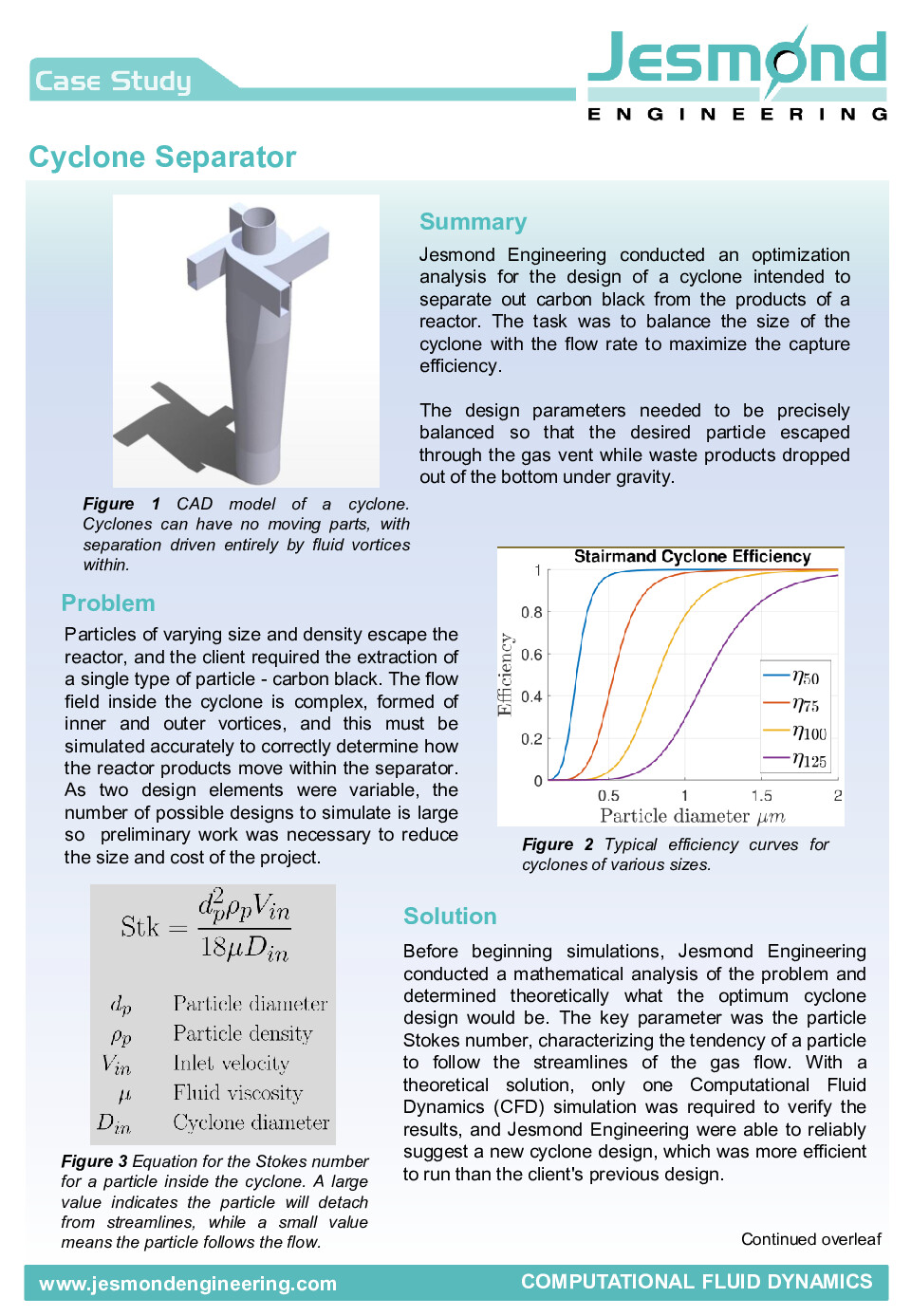
Particles of varying size and density escape the reactor and the client required the extraction of a single type of particle – carbon black. The flow field inside the cyclone is complex, formed of inner and outer vortices, and this must be simulated accurately to correctly determine how the reactor products move within the separator. As two design elements were variable, the number of possible designs to simulate is large so preliminary work was necessary to reduce the size and cost of the project.
Case Study
Cyclone Separator Case Study
The Problem
The Solution
Before beginning simulations, Jesmond Engineering conducted a mathematical analysis of the problem and determined theoretically what the optimum cyclone design would be. The key parameter was the particle Stokes number, characterising the tendency of a particle to follow the streamlines of the gas flow. With a theoretical solution, only one Computational Fluid Dynamics (CFD) simulation was required to verify the results, and Jesmond Engineering were able to reliably suggest a new cyclone design, which was more efficient to run than the client’s previous design.
Conclusion
Jesmond Engineering carried out theoretical and CFD analysis of the particle capture efficiency of a cyclone separator. This enabled Jesmond Engineering to suggest an optimized design based on the variable parameters provided by the client.
Benefits
Preliminary theoretical work reduced the amount of simulations required for the optimization process. This in turn reduced the time and cost of Jesmond Engineering’s delivery of results. In combination with CFD modelling of the compelx fluid-particle system, Jesmond Engineering could confidently propose a new cyclone design, improving capture efficiency and reducing running costs for the client.
Could we help with your next project?To discuss your next project with one of our experienced engineers, click below and leave your details. We’ll be in touch to arrange a call.