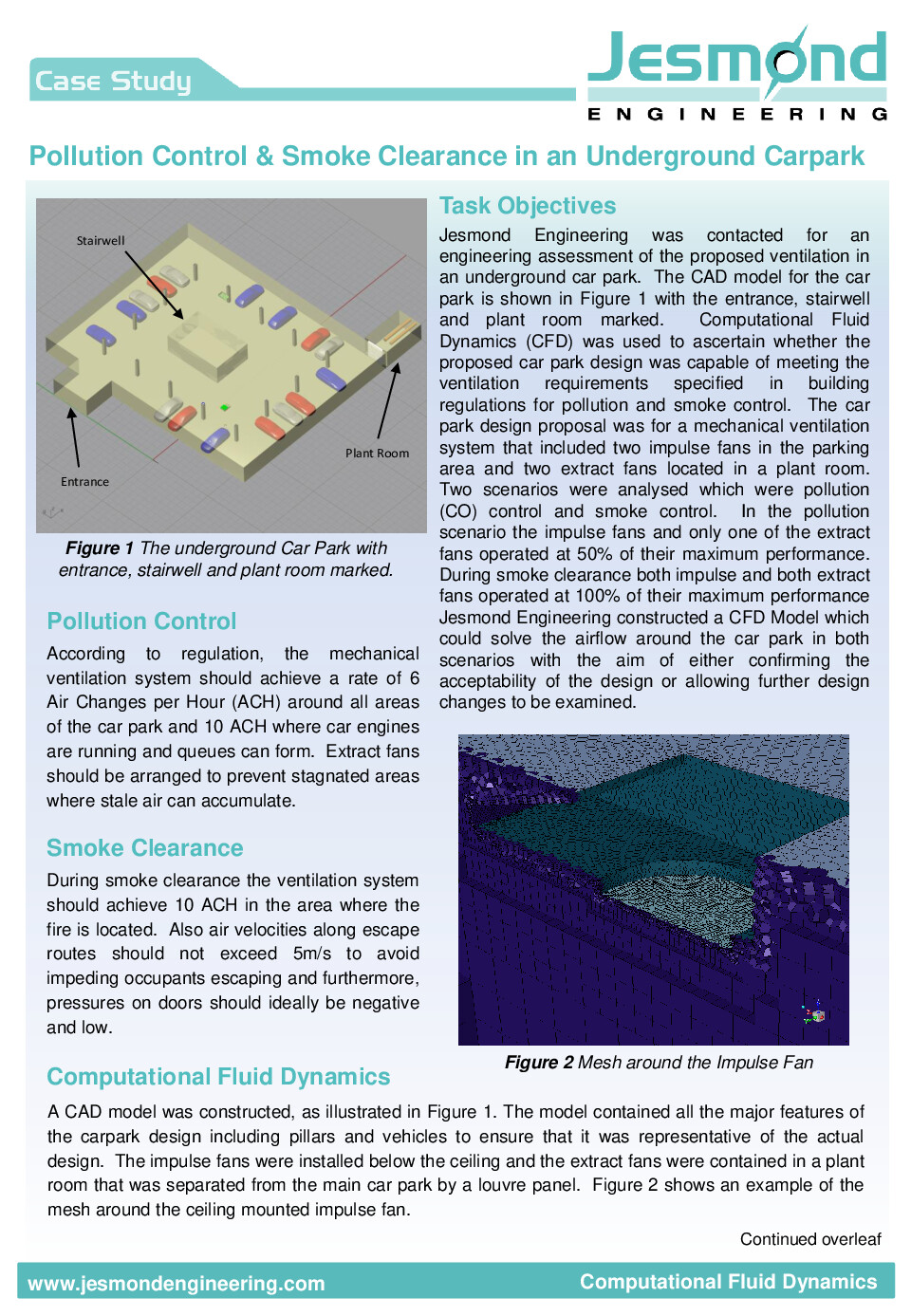
The airflow within an underground car park is a relatively complex system with a number of interdependent parameters in play. The physical dimensions and geometry of the space, the number and location of vehicles and the various passive and active ventilation factors all have an impact on air quality.
According to regulation, a mechanical ventilation system must achieve a rate of six air changes per hour throughout the car park. In areas where car engines are running and queues may form—and in the event of fire—this requirement increases to ten air changes per hour. This increased level of airflow must be achieved without exceeding five meters per second along escape routes or creating undue pressure on escape doors—both of which may impede the escaping occupants.
In a traditional scenario an initial specification for the car park ventilation system would be based on established guidelines and design experience. This specification would then be revised and optimised through a process of build and test until it can be demonstrated that the ventilation system meets regulatory requirements.
Once construction is underway it becomes impractical to make significant design changes to the building. If the initial ventilation system specification proves inadequate, then enhancements must be made. This can result in time delays and unpredictable additional costs.
An alternative, preemptive approach allows for contingency in the ventilation system at the initial design stage. But this over-specification can be unnecessarily costly, resulting in an increased budget or reduced profitability.
In an ideal scenario the physical components of the car park and the ventilation system could be manipulated during the design phase.
Jesmond Engineering constructed a CAD model of the proposed car park based on the client’s design. The model contained all the major physical features of the car park, including pillars, ramps, entrances, exits and of course the vehicles themselves.
Using computational fluid dynamics (CFD) Jesmond Engineering was able to accurately simulate airflow around the car park under various conditions, such as different numbers and locations of vehicles.
The ventilation system in the model was based on the client’s initial specification. Impulse fans were installed below the ceiling inside mesh enclosures. Extractor fans were installed in a plant room that was separated from the car park by a louvre panel.
Using CFD analysis Jesmond Engineering examined both the rate of airflow, and age and quality of air at various levels in the car park. The boundary conditions were modified to assess the impact of environmental changes, such as whether the car park entrance was opened or closed.
Jesmond Engineering was able to easily modify the CAD model to evaluate changes to the specification, such as relocating the impulse fans to increase the number of air changes when the building did not meet the regulatory requirements.
Jesmond Engineering conducted simulations for both pollution control and smoke clearance. The fans operate differently in the two scenarios and the results indicate the corresponding velocity and age of air throughout the car park.
In a pollution control scenario the CFD analysis was able to demonstrate the ventilation system achieving sufficient air movement to meet the required number of air changes per hour.
Similarly in a smoke clearance scenario, CFD analysis showed that the velocity of air at the car park entrance and stairwell escape route remained below the critical five meters per second. It was also possible to demonstrate that air pressures on escape doors were all negative.
Using a computer model of the car park and CFD analysis, Jesmond Engineering was able to demonstrate the viability of the proposed car park design and ventilation system while the project was still in its initial design phase.
CFD analysis was a cost effective way to assess the car park design under different scenarios and to demonstrate which would be acceptable against a set of regulatory requirements. This was all done prior to commencing the final build.
The model could quickly and cheaply be reconfigured to find the optimum specification, saving time and money over traditional build and test methods.
Based on the results of Jesmond Engineering’s analysis the client was able to confidently move forward with the project knowing that the specification for the car park ventilation system would be fit for purpose, legally compliant and within the specified budget.